Loneliness Epidemic in a Hyper-Connected World: Algorithms & Screens vs YOU
- Team Quikphyt

- Nov 13, 2025
- 12 min read
We live in the most “connected” era in human history—yet rates of loneliness, anxiety, and social disconnection are rising across age groups. Governments now describe loneliness as a public-health crisis, with health risks comparable to traditional lifestyle hazards like smoking and inactivity. (Department of Health and Human Services)
At the heart of this paradox are two modern forces:
Social Media Algorithms – ranking and recommending content to maximise engagement, not well-being.
Modern Electronic Appliances – smartphones, tablets, gaming consoles, smart TVs and wearables that keep us “always on” and rarely truly present.
1. Loneliness vs. Being Alone: Why This “Epidemic” Matters Biologically
Loneliness is not simply being alone; it is the subjective feeling that your social needs are not met. You can feel lonely in a crowd or deeply connected while physically alone.
Meta-analyses of large prospective cohort studies (millions of participants) show that:
Loneliness and social isolation increase risk of premature death from all causes. (PubMed)
People with strong social relationships have ~50% greater odds of survival compared with those with weak social ties. (PLOS)
Risk levels are comparable to, or in some analyses only slightly less than, major health risks like smoking and obesity. (Department of Health and Human Services)
Recent work using proteomics (studying thousands of blood proteins) shows that loneliness and social isolation are associated with altered levels of proteins involved in inflammation, immunity, metabolism, and cardiovascular risk—and many of these protein changes predict higher mortality, cardiovascular disease, stroke and type 2 diabetes. (The Guardian)
Key Point: Loneliness is not a “soft” or merely emotional issue. It is a biologically embedded stress state that reshapes the immune system, metabolism and brain, increasing long-term risk of chronic disease.
2. Where Technology Comes In: From Tools to “Social Slot Machines”
Digital technology itself is neutral. How it is designed and used determines whether it promotes connection or isolation.
2.1 Social Media Algorithms: Engines of attention, not connection
Modern social platforms use recommender systems and ranking algorithms to optimise for engagement metrics—clicks, likes, watch time, comments, reshares.
Reviews of digital media algorithms highlight that:
Evidence that algorithms alone cause large mental-health effects is still limited and often shows small average effects at population level. (PMC)
But algorithms shape what we see, reinforcing social status competition, outrage, polarisation, and often feeding us more of the content that keeps us scrolling—even if it worsens mood. (PMC)
A recent quasi-experimental study examining the introduction of a new algorithmic feed on a major image-sharing platform found worsened mental health outcomes among teenagers after the algorithm change, suggesting that algorithm design can push vulnerable users in a negative direction. (SSRN)
Short-form platforms amplify this further:
Violent or emotionally charged videos are more likely to be promoted, making teens feel unsafe in their own neighbourhoods and less willing to go out, reinforcing physical isolation. (The Guardian)
Highly viral mental-health “tips” videos often contain misinformation, oversimplifying serious conditions and potentially discouraging evidence-based help. (The Guardian)
2.2 Modern Electronic Appliances: Attention Fragmentation Machines
Smartphones, tablets, laptops, gaming consoles and smart TVs extend the reach of these algorithms into every corner of daily life.
Systematic reviews and large observational studies consistently link high total screen time with:
Higher adiposity and obesity risk. (PubMed)
Lower physical activity levels and poorer cardiovascular risk profiles. (PubMed)
Worse sleep quality and shorter sleep duration. (PMC)
Lower psychological well-being in heavy users, especially children and adolescents. (ScienceDirect)
Studies among medical students and youth in multiple countries, including India, show that prolonged screen use is associated with depression, anxiety, stress, poor sleep and cardiometabolic risk. (MSJ Online)
Bottom line: Algorithms dictate what we see; appliances ensure we see it all the time. Together, they create a 24/7 environment favouring passive consumption over real-world connection.
3. Does Social Media Actually Cause Loneliness? What the Data Say
The relationship between social media and loneliness is complex and bidirectional, not a simple “more use = more lonely” story.
3.1 Meta-Analyses: small average effects, but important details
A meta-analysis of social networking site use and loneliness found a small but significant positive association: more overall social media use correlated with slightly higher loneliness. However, the effect size was weak, and the type of use mattered. (Taylor & Francis Online)
Another meta-analysis of problematic media use found that loneliness is strongly associated with compulsive or addictive patterns of media use, suggesting that lonely individuals are more likely to fall into problematic use. (JMIR)
Studies in older adults indicate no strong overall relationship between simple “amount of social media use” and loneliness; instead, context and type of use appear crucial. (PubMed)
3.2 Active vs Passive Social media Use
Recent reviews and meta-analyses suggest:
Active use – messaging friends, posting, commenting, participating in groups – can be associated with greater perceived social support and sometimes higher well-being.
Passive use – endless scrolling, lurking without interaction, comparing one’s life to others – is more consistently linked to lower mood, envy, FOMO, and reduced well-being. (OUP Academic)
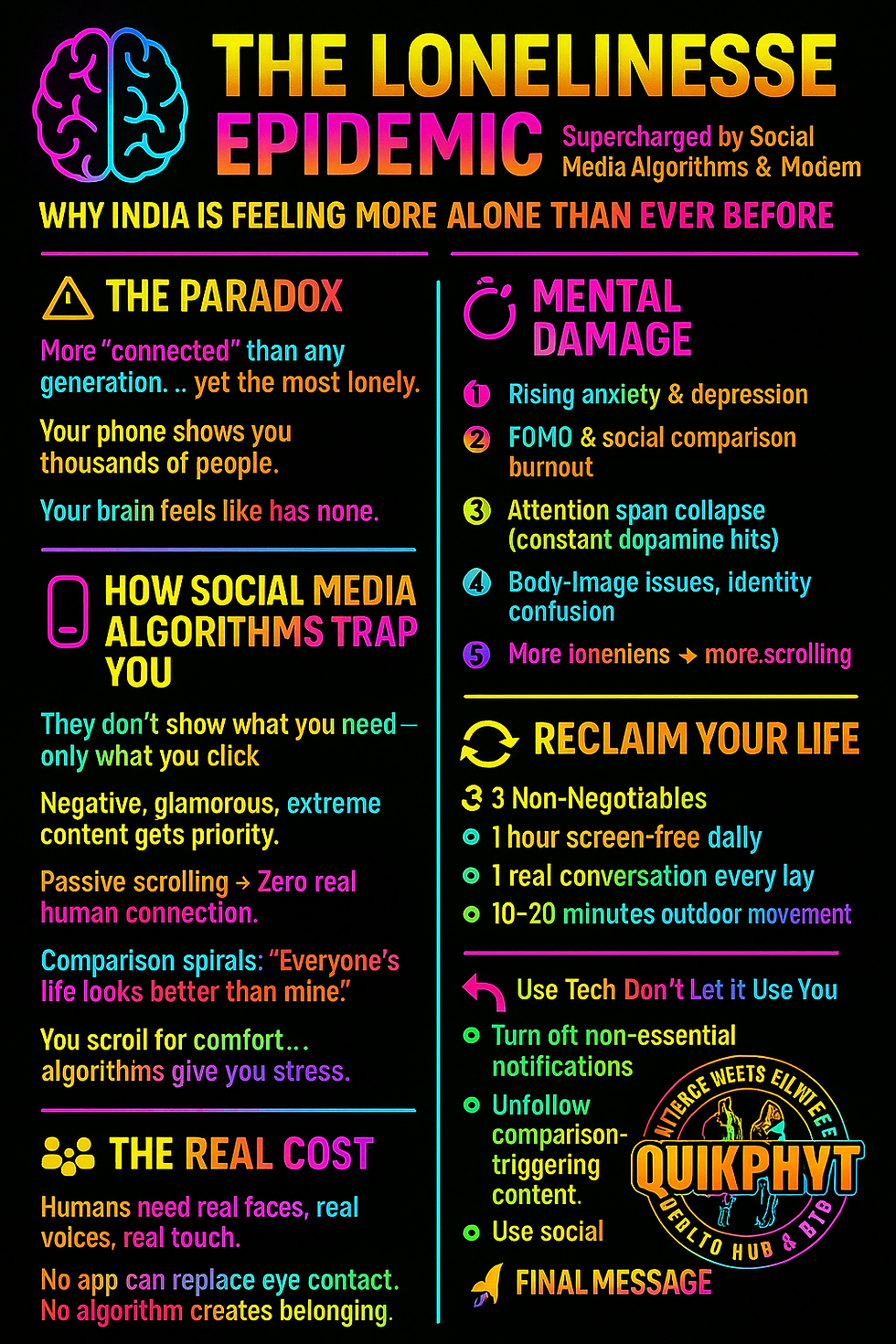
So the key is not just how much you use social media, but how and why you use it. Algorithms, however, are optimised to keep you in the passive, reactive mode (the most profitable mode for ad-driven platforms).
4. The “Digital Loneliness Spiral”: How Algorithms and Screens Accentuate Isolation
Putting all this together, we can see a characteristic pattern:
Initial Vulnerability
A person feels a bit lonely, stressed or insecure.
They turn to social media or screens “just to relax” or “feel connected.”
Algorithmic Pull Into Passive Consumption
The recommendation feed serves content tailored to their past clicks: highlight reels of others’ lives, beauty standards, success stories, outrage, or fear-based news.
Emotional, extreme and status-loaded content is more engaging, so it gets promoted.
Psychological Impact
Upward social comparison → “Everyone else is happier / more successful / more loved than me.” (PMC)
Fear of missing out (FOMO) → anxiety about being left out of events and experiences. (News Center)
Perceived social rejection or cyberbullying further worsens mood and self-esteem, especially in adolescents. (PMC)
Behavioural Changes
Increased time online, less time in physical social spaces (friends, family, clubs, outdoor activity).
Reduced motivation to go out due to safety fears (after exposure to violent content) or social anxiety. (The Guardian)
Sleep is delayed by late-night scrolling; fatigue next day further reduces social engagement and physical activity. (MSJ Online)
Deepening Loneliness and Problematic Use
As real-world connection shrinks, the person becomes more reliant on online “connection,” which often remains shallow and comparison-driven.
This pattern aligns with findings linking loneliness to internet addiction and social media use problems. (BioMed Central)
This is the digital loneliness spiral: loneliness → more screen use → deeper algorithmic pull → worse mental health → even more loneliness and digital escape.
5. Mental Harms: From Mood to Identity
5.1 Depression, Anxiety, and Self-Harm
Reviews and large studies report that:
Heavy social media and smartphone use among teenagers is associated with higher levels of depressive symptoms, anxiety and self-harming behaviours. (PMC)
High screen users among children and adolescents show lower psychological well-being, including less curiosity, lower self-control, more distractibility, and more emotional instability. (ScienceDirect)
Problems such as social media “addiction” (compulsive use with loss of control and withdrawal symptoms) are linked bidirectionally with low mental health. (ScienceDirect)
5.2 Cognitive and Attentional Effects
Excessive screen time and constant notification checking are associated with reduced sustained attention, more mind-wandering, and impaired academic performance. (PMC)
Swapping between multiple apps, chats and tabs trains the brain for continuous partial attention, making deep conversation and presence with others more difficult.
5.3 Identity, Self-Esteem and Social Comparison
Body-image concerns, disordered eating behaviours, and low self-esteem correlate with exposure to idealised or appearance-focused content, especially among girls and young women. (PMC)
Passive consumption of others’ highlight reels intensifies upward comparison, making one’s own life feel inadequate or boring. (News Center)
Algorithmic amplification of attention-seeking or extreme content encourages performative behaviour rather than authentic self-expression, further disconnecting people from their real identity and relationships.
5.4 Misinformation and “DIY mental health”
Analyses of viral mental-health content show that more than half of popular short-video “tips” contain significant misinformation or oversimplifications. (The Guardian)
This can trivialise real conditions (“everyone has trauma”), encourage self-diagnosis, and delay professional help, worsening loneliness and distress when quick-fix hacks inevitably fail.
6. Physical Harms: The Cost of the Loneliness–Screen Combination
The same technologies that amplify loneliness also reshape our bodies.
6.1 Sedentary Behaviour, Obesity and Cardiometabolic Risk
Systematic reviews, cohort studies and paediatric data consistently find that:
Higher screen time is associated with greater adiposity, obesity and poorer diet quality. (PubMed)
Children and adolescents with long daily recreational screen time show worse cardiometabolic risk scores (blood pressure, lipids, insulin resistance), predicting higher future risk of heart attack and stroke. (The Sun)
Screen time displaces physical activity and outdoor play, compounding the metabolic impact of loneliness-related stress. (PMC)
6.2 Sleep Disruption and Circadian Misalignment
Use of smartphones and tablets late into the night is strongly associated with shorter sleep duration, delayed sleep onset, daytime sleepiness and poorer sleep quality. (MSJ Online)
Blue-light exposure, constant notifications, and emotionally arousing content interfere with the body’s natural circadian rhythm, affecting hormone secretion (melatonin, cortisol) and appetite regulation. (PMC)
Poor sleep further increases risk of depression, anxiety, obesity and cardiometabolic disease—and also makes people more socially withdrawn, feeding back into loneliness.
6.3 Inflammation, Immune Function & Long-Term Disease
Loneliness is linked with elevated inflammatory markers, altered antiviral and immune responses, and protein signatures associated with higher risk of cardiovascular disease, stroke and metabolic disorders. (The Guardian)
When loneliness co-exists with sedentary behaviour, poor diet and sleep disruption (a classic high-screen-time profile), the inflammatory burden and metabolic risk multiply.
6.4 Musculoskeletal & Eye strain
Prolonged device use in fixed postures leads to neck and shoulder pain, headaches, and eye strain (“tech neck,” digital eye strain), which are now among the most common complaints in both youth and working adults. (Verywell Health)
These physical issues may seem minor day-to-day but contribute to reduced energy, more irritability, lower motivation to move or socialise—and thus more isolation.
7. Can Technology Also Help Reduce Loneliness? What Positive Research Shows
The story is not purely negative. When designed and used deliberately, digital tools can support social connection:
Systematic reviews of digital interventions (online support groups, video-chat programs, structured communication tools) show modest but real reductions in loneliness, especially in older adults and people with mobility limitations. (ScienceDirect)
Active participation in supportive online communities (e.g., niche interest groups, patient forums) can provide meaningful companionship, information and emotional validation—if they don’t replace offline ties entirely. (OUP Academic)
So the key is not to demonise technology, but to shift from being passively shaped by algorithms to actively shaping how we use tech.
8. Evidence-Based Strategies: How to Protect Brain, Body & Relationships
Here are practical, research-aligned strategies you can start today.
8.1 Redesign your Relationship with Social Media
Default to “active, intentional” use
Use social platforms primarily to message specific people, coordinate meet-ups, or participate in small, supportive groups.
Before opening an app, ask: “What am I here to do?” If you don’t have a purpose, skip it.
Limit Passive Scrolling Windows
Create specific daily time slots for social feeds (for example, two short windows) instead of constant “micro-checks.”
Many studies show mental-health risk climbs at high screen-time levels, while moderate use is less problematic. (BioMed Central)
Tame the Algorithm
Unfollow or “not interested” content that triggers comparison, fear or outrage.
Follow accounts that encourage offline action: local meet-ups, sports, volunteering, hobby groups.
Use chronological or “following-only” feeds when available, which reduce algorithmic amplification of extreme content. (PMC)
Beware Viral “Mental Health Hacks”
Treat short-form mental-health advice as entertainment, not therapy.
Cross-check serious claims with reputable organisations or clinical guidelines. (The Guardian)
8.2 Protect Your Sleep & Circadian Rhythm
Create a Device-free Wind-down Zone
Aim for a screen-free buffer before bed. Replace it with reading, stretching, or low-light conversation.
Keep phones out of the bed; if possible, out of the bedroom entirely. (MSJ Online)
Turn Off Non-essential Notifications
Disable push alerts for social media so you choose when to engage rather than being constantly summoned.
Use “Night Mode” and Lower Brightness
Although this does not fully solve the problem, it reduces blue-light intensity and glare, helping melatonin production. (PMC)
8.3 Move Your Body to Protect Your Mind
Pair Screen Time with Movement
Use standing desks or walk during audio or video calls when appropriate.
Set reminders to stand, stretch and walk every half hour during long screen sessions.
Daily Outdoor Time
Even moderate physical activity outdoors (walking, cycling, casual sports) improves mood, reduces inflammation and counters cardiometabolic risk associated with both loneliness and screen time. (Department of Health and Human Services)
8.4 Build “Analog Nutrition” for Social Health
Think of human connection as nutritional: you need regular servings of in-person, emotionally safe contact.
Set a “Daily Real-People Quota”
Aim for at least one meaningful face-to-face or voice conversation each day with someone you trust.
Deliberately Schedule Connection
Join clubs, sports teams, study groups, hobby circles or volunteering projects.
Use digital tools only as a bridge (to organise) rather than the final destination.
Micro-Connections Count
Short interactions with neighbours, shop staff or co-workers buffer stress and increase sense of belonging. Over time, these small ties accumulate into a powerful protective network. (PLOS)
8.5 When to Seek Professional Help
Consider professional support if you notice:
Persistent loneliness despite attempts to connect.
Ongoing sadness, hopelessness or anxiety.
Compulsive, uncontrollable social media or gaming use.
Thoughts of self-harm or suicide.
Evidence-based therapies and, when needed, medication can significantly reduce symptoms and improve functioning. Digital tools can support—but not replace—professional care. (apa.org)
9. Take-Home Messages
Loneliness is a biological stress state that increases risk for cardiovascular disease, metabolic disorders, cognitive decline and early mortality. (PubMed)
Social media algorithms and modern electronic appliances create a digital environment optimised for attention, not well-being, nudging many users into more passive, comparison-based, and isolating behaviours. (PMC)
Average correlations between social media use and loneliness are often small—but problematic, passive, late-night and high-dose use is reliably associated with worse mental and physical health. (Taylor & Francis Online)
Technology is not destiny: when used deliberately and in moderation, digital tools can support connection, especially for those who are geographically isolated or physically limited. (ScienceDirect)
The antidote is intentional design of your digital life: active use over passive, limits over constant exposure, offline relationships over algorithmic validation, and movement, sleep and real-world presence as non-negotiable pillars.
You are not weak for being affected by these systems—they are built to capture the human brain. But with awareness and structured habits, you can step out of the digital loneliness spiral and build a life where technology serves your relationships, not the other way around.
References
Holt-Lunstad J, et al. Social relationships and mortality risk: a meta-analytic review. PLoS Med. (PLOS)
Holt-Lunstad J, et al. Loneliness and social isolation as risk factors for mortality: a meta-analytic review. Perspect Psychol Sci. (PubMed)
U.S. Surgeon General. Our epidemic of loneliness and isolation: The U.S. Surgeon General’s advisory on the healing effects of social connection and community. (Department of Health and Human Services)
Harris E, et al. Social isolation, loneliness, and all-cause and cause-specific mortality: meta-analysis of prospective cohort studies. JAMA. (JAMA Network)
Smith RW, et al. Benchmarking social isolation, loneliness, and smoking as risk factors for mortality. Prev Med. (PubMed)
Guardian Science. Loneliness linked to ill health through effect on protein levels, research suggests. (The Guardian)
Metzler H, et al. Social drivers and algorithmic mechanisms on digital media and adolescent mental health. Curr Opin Psychol. (PMC)
Mandile S. The Dark Side of Social Media: Recommender Algorithms and Teen Mental Health. SSRN Working Paper. (SSRN)
De D, et al. Social media algorithms and teen addiction: neurobiological effects of prolonged social media use. Front Psychiatry. (PMC)
Stiglic N, Viner R. Effects of screen time on the health and well-being of children and adolescents: a systematic review of reviews. BMJ Open. (PubMed)
Priftis N, et al. Screen time and its health consequences in children and adolescents: an umbrella review. Children. (PMC)
Zablotsky B, et al. Associations between screen time use and health outcomes among adolescents. Prev Chronic Dis. (CDC)
Twenge JM, et al. Associations between screen time and lower psychological well-being among children and adolescents. Prev Med Rep. (ScienceDirect)
Santos RMS, et al. The associations between screen time and mental health in adolescents: a systematic review. BMC Psychol. (BioMed Central)
Wang Y, et al. Relationship between loneliness and internet addiction: a meta-analysis. BMC Public Health. (BioMed Central)
Fam JY, et al. Loneliness and problematic media use: meta-analysis of longitudinal studies. J Med Internet Res. (JMIR)
Zhang L, et al. Social networking site use and loneliness: a meta-analysis. J Psychol. (Taylor & Francis Online)
Godard R, et al. Are active and passive social media use related to mental health? A systematic review. J Comput Mediat Commun. (OUP Academic)
Dienlin T, Johannes N. The impact of digital technology use on adolescent well-being. Dialogues Clin Neurosci. (Taylor & Francis Online)
Cataldo I, et al. Social media usage and development of psychiatric disorders in childhood and adolescence: a review. Front Psychiatry. (Frontiers)
Khalaf AM, et al. The impact of social media on the mental health of adolescents and young adults. Middle East Curr Psychiatry. (PMC)
University of Texas at Dallas. Psychologists examine mental toll of passive social media use and FOMO. (News Center)
APA. Health advisory on social media use in adolescence. American Psychological Association. (apa.org)
Boer M, et al. Social media use intensity, social media use problems, and mental health: a three-wave longitudinal study. Comput Human Behav. (ScienceDirect)
Hansen T, et al. Digital bridges to social connection: a systematic review and meta-analysis of loneliness interventions using technology. Comput Human Behav Rep. (ScienceDirect)
Verywell Health. What happens to your body when you have too much screen time. (Verywell Health)
MSJOnline & IJTPR systematic reviews on smartphone overuse and mobile screen time effects on mental, physical and sleep health. (MSJ Online)
Youth Endowment Fund & media reports. Violence on social media making teenagers afraid to go out. (The Guardian)
Guardian investigation. More than half of top mental health TikToks contain misinformation. (The Guardian)
Journal of the American Heart Association study and summary articles on screen time and cardiometabolic risk in youth. (The Sun)


Comments