Your Feet Decide How You Age: The Hidden Gait System Controlling Posture, Pain, Fat Loss & Longevity

FEET & GAIT MECHANICS
The Foundation of Posture, Balance, Performance & Lifelong Mobility
Your feet are not passive structures. They are sensory organs, shock absorbers, propulsion engines, and postural controllers.
Every step you take sends information to:
Your brain
Your spine
Your hips
Your breathing system
Your balance system
If your feet fail, everything above compensates.
Most knee pain, hip pain, back pain, poor posture, low athletic efficiency, and even early fatigue begin at the feet.
Longevity science is blunt:
Gait speed, balance, and foot strength strongly predict lifespan and independence.
1. FOOT ANATOMY: A MASTERPIECE OF ENGINEERING
Bones (26 per foot)
Hindfoot (calcaneus, talus): shock absorption
Midfoot: force transfer
Forefoot: propulsion
Arches
Medial longitudinal (spring)
Lateral longitudinal (stability)
Transverse (adaptability)
Muscles
Intrinsic foot muscles (stability, arch control)
Extrinsic muscles (power, propulsion)
Key Insight: Flat feet are not weak bones — they are undertrained muscles and poor neural control.
2. THE FOOT–BRAIN CONNECTION
Feet contain:
Thousands of mechanoreceptors
Proprioceptive sensors
They inform the brain about:
Surface
Load
Direction
Speed
Shoes that numb sensation → brain loses feedback → balance and posture decline.
3. GAIT: HOW YOU MOVE THROUGH LIFE
Normal Gait Phases
Heel strike (shock absorption)
Mid-stance (stability)
Toe-off (propulsion)
Problems occur when:
Heel strike is too hard
Arch collapses without control
Toe-off is weak
This leads to:
Knee pain
Hip rotation issues
Back pain
Neck tension
Energy loss
4. GAIT SPEED = LONGEVITY
Research shows:
Faster, efficient walkers live longer
Slower gait predicts:
Dementia
Frailty
Cardiovascular risk
Walking is not basic. It is biological intelligence.
5. COMMON FOOT DYSFUNCTIONS
Over-pronation
Collapsed arches
Plantar fasciitis
Heel pain
Bunions
Achilles tightness
Weak toe flexors
Most originate from foot weakness + shoe dependence.
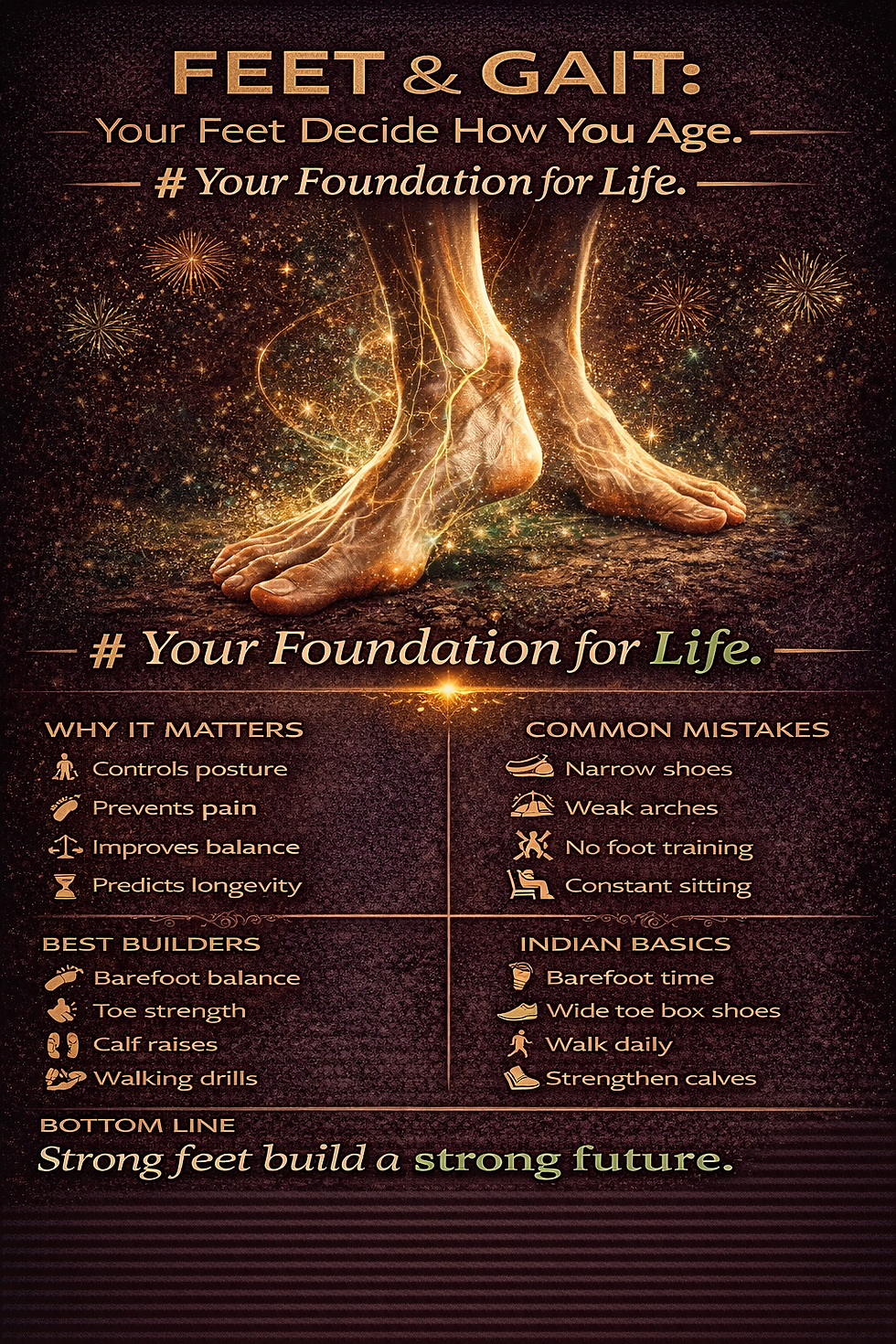
6. BEST STRENGTH TRAINING FOR FEET
A. Intrinsic Muscle Training
Short-foot exercise
Toe spreading
Toe yoga (independent toe control)
B. Calf–Achilles Complex
Slow calf raises (straight & bent knee)
Eccentric heel drops
Strong calves = elastic walking and running.
C. Balance & Proprioception
Single-leg stands
Barefoot balance
Uneven surface training
D. Loaded Carries
Carry load → feet learn to stabilize reflexively.
7. CALISTHENICS & FUNCTIONAL MOVEMENT
Barefoot squats
Lunges with controlled foot tripod
Step-ups
Crawling
Feet must grip the ground.
8. YOGA & FOOT HEALTH
Highly effective asanas:
Tadasana (arch awareness)
Malasana (ankle + foot mobility)
Vrikshasana (balance)
Downward dog (plantar stretch)
Yoga restores foot-ankle-hip chains.
9. CARDIO & GAIT TRAINING
Walking (varied terrain)
Incline walking
Barefoot drills (controlled environment)
Avoid:
Excess treadmill + shoes + phones
Walk tall. Look ahead. Breathe nasally.
10. SHOES: THE DOUBLE-EDGED SWORD
Problems:
Narrow toe boxes
Over-cushioning
Rigid soles
Guidelines:
Wide toe box
Flexible forefoot
Use shoes as tools, not crutches
Barefoot time is neurological training.
11. INDIAN CONTEXT
Hard floors + footwear indoors
Cultural barefoot walking (advantage)
Sedentary jobs reduce foot strength
Flat footwear without support for weak feet
Indian hack: Barefoot time + foot exercises = massive improvement.
12. FEET ACROSS AGE & GENDER
Children
Barefoot play develops arches naturally
Adults
Foot training reduces knee & back pain
Women
Narrow footwear → bunions & instability
Men
Weight gain compresses foot arches
Seniors
Foot strength = fall prevention
13. NUTRITION FOR FOOT & CONNECTIVE TISSUE
Protein (collagen support)
Vitamin C
Magnesium
Omega-3
Hydration
Tendons and fascia are metabolically active tissues.
14. COMMON MISTAKES
Ignoring feet in training
Only stretching plantar fascia
No intrinsic strengthening
Tight shoes
Walking with poor posture
Excess sitting
15. FINAL TAKEAWAY
Your feet are your foundation. Weak feet = weak posture = weak movement = faster aging.
Train your feet. Your entire body becomes younger.
SCIENTIFIC REFERENCES
Lieberman et al. – Foot Strike & Biomechanics
Robbins & Hanna – Foot Proprioception
Perry – Gait Analysis
Nature Aging – Gait Speed & Longevity
WHO Mobility & Fall-Prevention Guidelines


Comments